Chapter one · from the book
Though She May Forget…
“Can a mother forget the baby at her breast and have no compassion on the child she has borne? Though she may forget, I will not forget you. See, I have engraved you on the palms of my hands.”Isaiah 49:15–16
When people meet me today, they see the smile before they see the scars. They see the career, the qualifications, the confidence and the achievements. What they don't see is the little girl from NU30, Motherwell, who once wondered whether life would ever get better. This is the story of that little girl… and of a God who never forgot her.
I was born in Gqeberha, formerly Port Elizabeth, and raised in NU30, Motherwell, one of the township's poorest neighbourhoods. I am the second of three daughters raised by an incredibly resilient Xhosa woman from Greenbushes, Port Elizabeth, my mother, Annie Nikelwa Gaba, Marhadebe (clan-name). She worked as a domestic worker, leaving home before sunrise and returning long after sunset, doing everything she could to provide for her three girls. I never knew my father.
In 1998, when I was still very young, we moved to NU30. Our first home was a tiny shack that offered little more than shelter. Space was so limited that every corner had to serve more than one purpose. Life in the shack was difficult, but to us it was simply home because we knew nothing else.
Then, in 2002, everything changed. My mother received an RDP house. To many people, it may have looked like an ordinary government-built house, but to us, it felt like we had been upgraded to a mansion. For the first time, we had solid walls, proper rooms, and a place that truly felt like our own. Looking back now, I smile at how excited we were over something many people might have overlooked. It wasn't luxury, it was security, dignity and hope, but even that tells only part of the story.
Wanting her daughters to have a little more space, my mother added wooden extensions to parts of the house, making the rooms slightly larger. The roof leaked when it rained, the winters were bitterly cold, and the house was far from perfect.
Before anyone saw the cracked walls or the wooden extensions, they saw the little table at the entrance. Covered with a spotless white cloth, it displayed porcelain dolls and delicate ornaments that my mother had brought home from work.
To a visitor, they were simple decorations. To us, they were proof that beauty could exist even in poverty.
My earliest memories are not of holidays or expensive toys, but of survival, resilience, and quiet hope. They are memories of a mother carrying burdens I only came to understand as an adult, and of three little girls trying to make sense of a world that often felt unfair. Looking back now, I realise that although life seemed to have forgotten us, God never did. Even before I knew Him for myself, He was already writing a story that would one day become my testimony.
Growing Up Too Soon…
“So do not fear, for I am with you; do not be dismayed, for I am your God. I will strengthen you and help you; I will uphold you with my righteous right hand.”Isaiah 41:10
Growing up in a single-parent home, raised by a mother who was doing everything she could just to survive, life was never easy. Every day felt like a battle against circumstances far bigger than a child should ever have to face. Like every other child, I wanted to feel normal but there was nothing that felt normal about my life.
First of all, I looked different. I had long, soft, and curly hair, fair skin, light brown eyes and features that made people assume I was the child of a Black and White couple. Ndandingathi ndingumlungu phakathi kwabantu abamnyama. But I wasn't the kind of "umlungu" people imagined. Ndandingumlungu osokolayo, oxwebileyo, living in a leaking shack where poverty was my everyday reality. Hayi, ayenzi sense nyani.
I remember one afternoon, walking home from school, feeling thirsty. I stopped at a house to ask for a glass of water. Before I could even get any, the children there started teasing me. They told me I had to "khumsha" first before they would give me water. In our township, "ukukhumsha" meant speaking English. They assumed that because I looked "white", I had to speak English too.
I couldn't help but laugh at the irony. Here I was, a child who looked like she came from privilege, yet I was walking home to a leaking shack, wearing the weight of poverty just like everyone else. My appearance often told a story that my reality couldn't support.
The uncertainty of not knowing became part of my everyday life. I never knew what I would wear the next day or whether there would be anything to eat before I left for school. Lunch time, especially, came with its own anxieties. Some days I was fortunate enough to take leftovers that my mother had brought home from work. Other days it was bread with the mould carefully cut away or burnt amagwinya or umbhako because there wasn't enough oil to fry them properly. And on many days, there was simply no lunch at all.
I still remember how other children would choose a lunch partner by locking pinkies together, making a little promise to share everything they had brought from home. Mna ndandisoloko ndiphunywa kula mngeno. Looking back now, I don't even blame them because, honestly… who would have wanted to share with me?
When the teacher announced that it was break time, I was usually the first one out of the classroom. It wasn't because I was excited to play. It was because my stomach was empty. Isisu asithethi lonto. Hunger doesn't care about dignity or pride. When you're hungry, you're hungry.
There were days when I found myself hovering around the school kitchen, where the mothers preparing the meals had begun to notice me. They saw how often I passed by, always finding one excuse or another to be there. Eventually, they understood why. Out of kindness, they would sometimes give me a loaf of bread, biscuits or leftover jam to take home. It may have seemed like a small gesture to them, but to us it meant that there would be something to eat that evening.
Living like that meant I was always expecting the next problem to arrive. I never woke up wondering what exciting adventure the day would bring. Instead, I wondered what challenge we would have to survive next. Childhood, for me, was less about carefree laughter and more about learning how to endure.
Perhaps what made those years even harder was that I had nowhere to take my pain. The one person I longed to run to for comfort was the very person I was afraid of burdening. My mother carried so much herself that approaching her with my own struggles felt impossible. Before I even spoke, I already knew what her response would probably be:
"So ndithini ke ngoku mna?" ("So what must I do now?")
As children, we didn't understand her. She always seemed angry. Every day she looked frustrated, exhausted and overwhelmed, and we were afraid of that anger because we didn't know where it came from. We could see that something weighed heavily on her heart, but we were too young to understand what it was.
Those words, whether spoken or simply anticipated, taught me to keep my pain to myself. Ndafunda ukuthula nentlungu ndifele ngaphakathi. I learned to swallow my tears because I didn't know where else to put them. I became a child carrying burdens that belonged to adults.
Sometimes I would quietly ask myself questions no child should ever have to ask. "Is this really my mother? The woman who gave birth to me? Why do I feel so alone when she is right here?"
Looking back now, I no longer ask those questions with the same heart. Today I understand that my mother wasn't withholding love because she didn't care. She was carrying burdens that no one had helped her carry. Poverty, loss, disappointment and the responsibility of raising three daughters alone had left little room for softness. As a child, I couldn't see that.
Part 2
"I was young and now I am old, yet I have never seen the righteous forsaken or their children begging bread."Psalm 37:25
By the time I was twelve years old, childhood and responsibility had become inseparable. Our circumstances pushed me to find ways of making money, not because anyone expected me to, but because I could see how hard my mother was fighting for us. She was doing everything she possibly could, yet the reality was that one income could never meet every need in our home.
So I became a little entrepreneur.
I braided people's hair, sold chips, amashwam-shwam, and even little bundles of tobacco wrapped in plastic (inkqotyi). Every rand I made felt important because I knew it could make a difference at home. Whenever I finished braiding someone's hair and got paid, I would hand the money to my mother. She would give me a small portion to keep and use the rest to buy whatever we needed most at the time. Looking back now, it amazes me how naturally responsibility found me. At an age when most children were asking their parents for money, I was trying to contribute to the household.
As I grew older, another responsibility was added to my shoulders — looking after my little sister, Nhopi. Every morning I had to make sure she got to creche safely, and every afternoon I had to bring her back home. Yoh, that child did not give me a chance to enjoy my freedom! Whenever my friends called me to come and play, there she was — ethe nca okomsila, following me everywhere because my mother had trusted me to keep an eye on her. At the time I used to complain endlessly.
"Yho, kutheni kufuneka ahambe nam ngalo lonke ixesha?" — meaning, why must she always be with me.
To make matters worse, she was my mother's little detective. Every small thing I did somehow found its way back home. Wayexela yonke into kumama! I honestly didn't enjoy taking her everywhere because I already knew she'd report me. Looking back now, though, I smile. My mother wasn't trying to spoil my fun. She simply trusted me. In a world that often felt uncertain, she knew her youngest daughter would be safe with me.
But long before that responsibility was placed on my shoulders, our family had already experienced a heartbreak that changed us forever. Three years earlier, my eldest sister passed away after a long illness. She wasn't just my sister, she was my mother's right hand, she was the one who carried hope for all of us. By then she had completed her nursing studies and was only waiting for the opportunity to begin working. We all believed that once she started earning an income, life would finally become easier.
For the first time in a long time, it felt as though our family's breakthrough was within reach.
Then everything changed. She passed away before that dream could become a reality. No words can fully describe what that loss did to our family.
Looking back now, I realise that my mother didn't only lose a daughter, she lost her greatest source of hope. The future she had imagined for our family disappeared together with her child. Then, just when we thought the pain couldn't become any heavier, something happened that still breaks my heart whenever I think about it.
About two weeks after my sister's funeral, the telephone rang. It was the hospital. They were calling to tell my mother that my sister needed to report for duty because she was appointed as a professional nurse. Imagine that!!
The very opportunity she had worked so hard for had finally arrived, but she was no longer here to answer the call. I often wonder what went through my mother's mind in that moment. She had already buried her daughter and now she was receiving the news we had all been waiting for. The timing felt unbearably cruel. That phone call wasn't just about a job, it represented everything my mother had hoped for, financial relief, stability and a different future for her children.
Instead, it became another painful reminder of everything she had lost. As a child, I didn't fully understand the depth of my mother's grief. I simply knew that something inside her had changed.
Only now, as an adult, can I appreciate how impossible it must have been to carry that kind of heartbreak while still waking up every morning to raise two young daughters, go to work, cook, clean, and somehow keep life moving. Looking back, I think part of the anger I saw in my mother wasn't anger at all. It was grief.
The kind of grief that never really leaves you and yet, despite everything that had happened, I was still a happy child. Maybe that's what children do. They find light even in the darkest places.
Chapter one ends here. The rest of the story — the marriage, the divorce, the God encounter, and the decision that it ends with me — is in the book.
Order your copy — R300 Back to the site
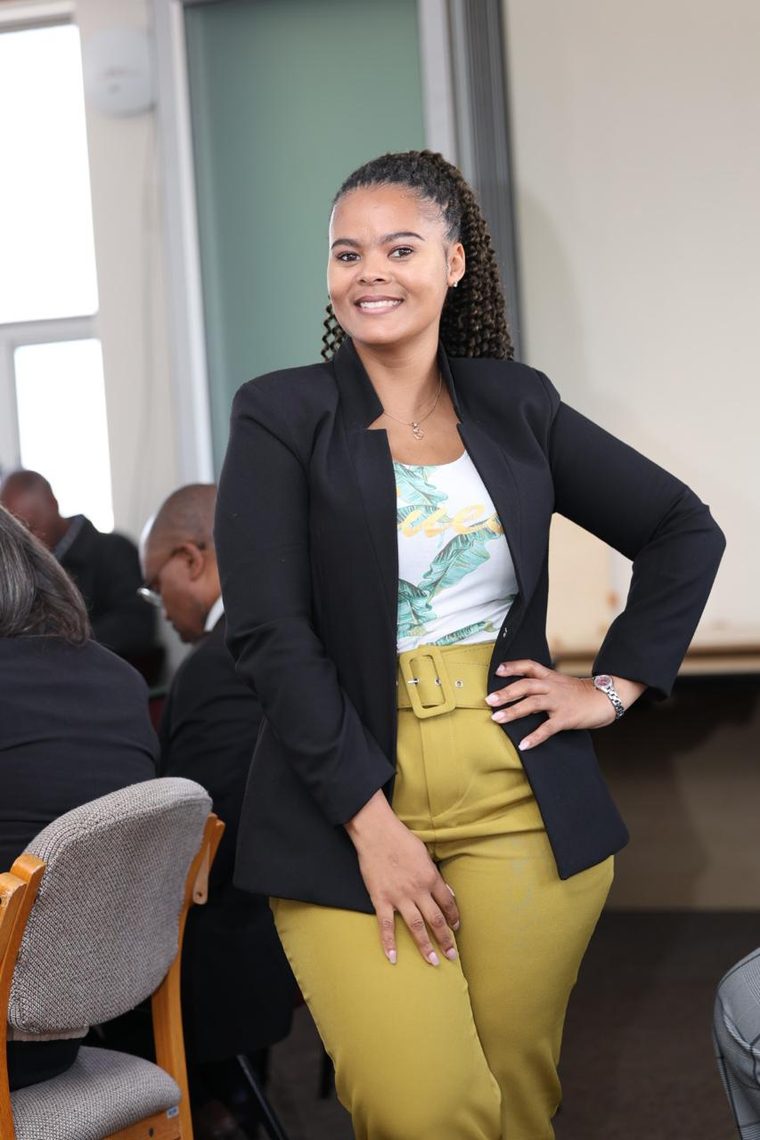
Angel Thuleka GabaNU30, Motherwell · Gqeberha